
Disguised for a Reason: Paranormal Encounters Are Spiritual Deceptions
If they’re not evil, why then are all the movies about them… evil.
In a world that’s all about paranormal investigations and trying to connect with the other side, we have to wonder: Who are these spirits really?
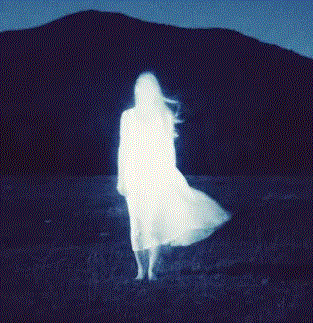
I’ve got one main point to make: if ghosts are real, why are they dressed?
The classic skepticism about ghosts wearing clothes really gets to the core: if a spirit is just an immaterial soul or consciousness without its physical body, why would it bring along something like a polyester suit, 17th-century clothing, or a Victorian nightgown when crossing over? This clothing conundrum challenges the usual ghost stories from a few logical perspectives:
The Inanimate Manufacturing Problem:
Clothes aren’t living things with spirits or souls; they’re made of cotton, leather, metal buttons, and synthetic dyes. For a ghost to show up in clothes, either those garments have their own afterlife, or our imagination just can’t handle the idea of a naked spirit, making us project our own need for modesty onto the supernatural.
Clothes aren’t living things with spirits or souls; they’re made of cotton, leather, metal buttons, and synthetic dyes. For a ghost to show up in clothes, either those garments have their own afterlife, or our imagination just can’t handle the idea of a naked spirit, making us project our own need for modesty onto the supernatural.
The Wardrobe Maintenance Paradox:
If clothes stick around after death, do they age, get torn, or need washing? A ghost in a blood-stained soldier’s uniform suggests that the fabric holds onto the trauma, or that the spirit deliberately chooses to show up in a specific, worn-out outfit every time it haunts a place.
If clothes stick around after death, do they age, get torn, or need washing? A ghost in a blood-stained soldier’s uniform suggests that the fabric holds onto the trauma, or that the spirit deliberately chooses to show up in a specific, worn-out outfit every time it haunts a place.
The Evolutionary Timeline Mismatch:
Our human ancestors supposedly roamed the earth for hundreds of thousands of years without clothes or just in animal skins. Yet, you hardly ever hear about a naked caveman ghost;. Most specters show up in recognizable, culturally specific historical outfits, indicating that ghost sightings are more about our mental images based on historical clothing styles than actual encounters.
Our human ancestors supposedly roamed the earth for hundreds of thousands of years without clothes or just in animal skins. Yet, you hardly ever hear about a naked caveman ghost;. Most specters show up in recognizable, culturally specific historical outfits, indicating that ghost sightings are more about our mental images based on historical clothing styles than actual encounters.
on the Origin of Ghost OrbsWho decided ‘they’ are spirits?
The idea of ‘orbs’—those glowing, see-through circles or spheres that pop up in flash photos—being called ghosts is a pretty recent concept that came about when early consumer tech met the rise of the pseudoscientific craze in early 2000’s paranormal TV shows. Before digital cameras and affordable camcorders became the norm in the late ’90s, ghosts were usually depicted as full-bodied figures, shadows, or mist. The whole ‘orb’ phenomenon took off mainly because of backscatter in digital photography: tiny, out-of-focus particles like dust, pollen, moisture, or even bugs floating just in front of the camera lens catch the flash, turning into big, glowing, see-through discs in the final shot.
Ghost-hunting TV shows and paranormal enthusiasts jumped on these photo oddities as cheap, endlessly reproducible ‘evidence’ of the spirit world since they could be snapped in just about any dusty room or old building. Instead of recognizing basic optics and physics, popular culture turned these floating dust particles into disembodied souls, effectively transforming camera lens quirks into modern folklore.
The theological view that ghosts aren’t the souls of the dead but rather deceptive demonic entities posing as spirits, is a long-standing belief found in various religious traditions, especially in conservative Christian demonology. This perspective changes the paranormal from being a mystery of unfinished human business to a deliberate, calculated metaphysical trick.
Several key arguments support this viewpoint:
The Finality of the Afterlife:
In traditional Christian teachings, scripture indicates that human consciousness doesn’t linger on Earth after death. the Bible says that ‘people are destined to die once, and after that to face judgment’, leaving no room in theology for souls stuck in limbo, haunting hallways, or unfinished business.
In traditional Christian teachings, scripture indicates that human consciousness doesn’t linger on Earth after death. the Bible says that ‘people are destined to die once, and after that to face judgment’, leaving no room in theology for souls stuck in limbo, haunting hallways, or unfinished business.
The Breakdown of Imitation:
If human souls can’t wander the earth, then any being that appears as a deceased loved one is a fake. From this religious view, fallen angels or demonic entities have a supernatural understanding, enabling them to tap into memories, imitate voices, mimic looks, and take advantage of profound sorrow or yearning to trick the living.
If human souls can’t wander the earth, then any being that appears as a deceased loved one is a fake. From this religious view, fallen angels or demonic entities have a supernatural understanding, enabling them to tap into memories, imitate voices, mimic looks, and take advantage of profound sorrow or yearning to trick the living.
The Risks of Necromancy and Divination:
Interacting with spirits—whether through mediums, ouija boards, or just casual ghost hunting—is seen in these beliefs as opening a spiritual gateway to harmful entities. The main goal of these appearances isn’t just harmless haunting; it’s about spiritual manipulation, steering people away from traditional faith by making occult practices seem valid through what appear to be innocent or comforting experiences (like a ‘friendly’ relative sending a reassuring message from the other side).
Interacting with spirits—whether through mediums, ouija boards, or just casual ghost hunting—is seen in these beliefs as opening a spiritual gateway to harmful entities. The main goal of these appearances isn’t just harmless haunting; it’s about spiritual manipulation, steering people away from traditional faith by making occult practices seem valid through what appear to be innocent or comforting experiences (like a ‘friendly’ relative sending a reassuring message from the other side).
By viewing apparitions as disguised spirits, this viewpoint sees the emotional comfort or familiarity of a ghost sighting not as evidence of a loved one’s presence, but as a clever trick of an elaborate illusion.